
Managing the Decline
Don't let it turn into a free-fall.

Sure, aging changes things. Many things. Our VO2 max declines. Our speed drops as our quickness fades, balance becomes less predictable, and our strength decreases a little— thankfully not as much as you think. None of that is news to anyone over forty. The problem, however, is many of us attribute far too much of the severity of these changes to aging itself… and not nearly enough to the absence of training.
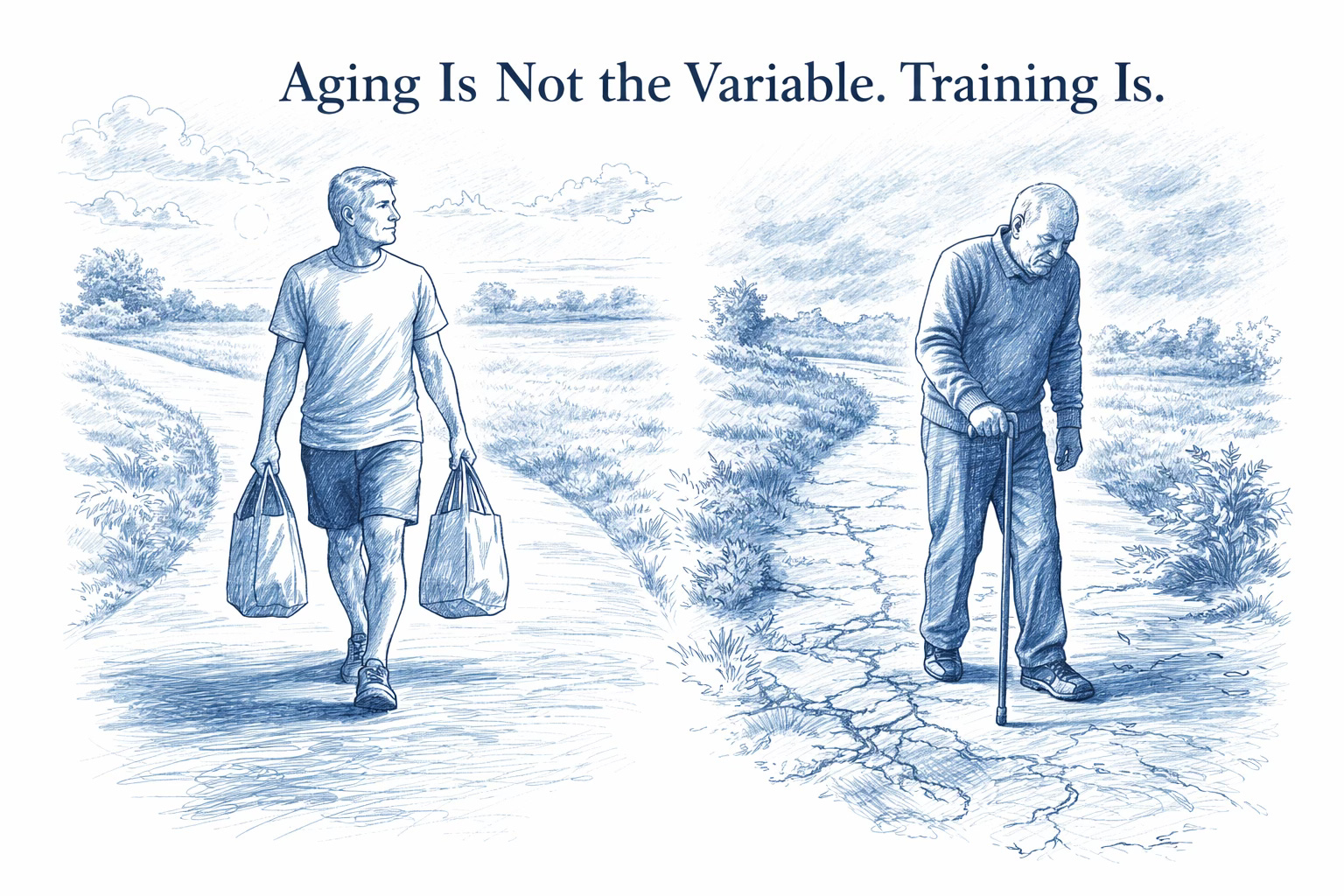
The 60-year-old who cannot get off the floor easily did not lose that ability because they turned 60. They lost it because they stopped getting on the floor 20 years ago.
The 50-year-old who gets winded walking up stairs did not lose their aerobic capacity because of a calendar number. They lost it because they stopped challenging their cardiovascular system.
The 70-year-old with poor balance did not develop the problem overnight. They stopped doing things that required balance decades ago.
Yes, the decline is real. I am not arguing otherwise. But the magnitude of that decline is largely determined by what you do, and the habits you’ve built, not simply by how old you are.
A longitudinal study from Sweden followed 427 individuals from age 16 to 63, measuring aerobic capacity, muscular endurance, and jump height at multiple time points over 47 years (Westerståhl et al. 2025). The variance in physical capacity between individuals increased enormously with age. For relative aerobic capacity, the variance between participants grew 25-fold from adolescence to age 63. At 16, the group looked relatively similar. By 63, some participants maintained excellent physical capacity while others had essentially collapsed.
The study confirmed what we would expect — aerobic capacity and muscular endurance peak somewhere between the mid-20s and mid-30s in both men and women, then decline gradually at first and more steeply after 45. The overall decline from peak to age 63 ranged from 30 to 48 percent across measures. But those who were physically active in their leisure time performed significantly better across all outcomes. And those who switched from inactivity to activity at any point in adulthood saw improvements of 6 to 11 percent, regardless of when they started. I would read that last sentence again. The research is clear… even a 90-year-old can make new muscle protein after a training session.
Yes, it is true that you cannot stop the decline entirely. Peak capacity occurs in your late 20s to mid-30s, and after that, you are managing the descent. But managing a descent is very different from free-falling. You can train and maintain strength. You can preserve aerobic capacity. You can practice balance. You can keep doing the things that require physical ability so that your body retains the ability to do them. This can be done through gym exercises, at home, or as part of your gardening or other home projects.
Getting Comfortable With Being Uncomfortable

When we push to a limit that the brain perceives as “dangerous,” many beneficial adaptations occur. Hundreds, yes, literally hundreds of compounds are released from our muscles that promote numerous beneficial downstream adaptations throughout the body. This internal pharmacy is more potent and protective than anything you can purchase.
Most of the abilities people lose between 40 and 70 are not due solely to aging. It is deconditioning masquerading as aging. It is the compound effect of thousands of small decisions to sit instead of move, to avoid instead of challenge, to accommodate instead of adapt. Training requires consistent effort — the boring repetition of fundamental movements, progressive loading, Zone 2 work, and regularly pushing yourself out of your comfort zone. It might not be glamorous, but it is effective.
Another Day With My Strength Coach

Last week, I published a typical Wednesday workout. Thank you for all the messages and suggestions. I promised to continue these, since many of you are looking for ways to mix up or enhance your current workouts.
Not training is easier in the short term. No gym memberships, no early morning workouts, no soreness the next morning, and no schedule disruptions. In the long term, though, it becomes catastrophically harder to navigate daily challenges, navigate the landscape, and remain functionally independent.
We know from the research that important lifestyle changes — sleep, diet, and exercise — can delay the onset of obvious functional decline by 10 to 20 years. That is not a small number.
Aging gives you permission to decline. It does not require that you free-fall through the process.
Reference: Westerståhl M, et al. “Rise and Fall of Physical Capacity in a General Population: A 47-Year Longitudinal Study.” Journal of Cachexia, Sarcopenia and Muscle. 2025. doi:10.1002/jcsm.70134
You also need to actively use your mind as you age. Learn new things, challenge yourself. Mental aging can be more harmful than physical aging if you don't stay physically and mentally active.
This really really hits home foe me. At 71, still cranking it out, albeit slower. Wouldn't have it any other way. I'm curious why others decide to "give it up"? The passive lifestyle just seems less satisfying.