

Tennis elbow affects roughly 1 to 3 percent of the general population at any given time — and over a lifetime, virtually everyone will experience it at some point. The vast majority of people who develop it have never played tennis. They are carpenters, surgeons, office workers, gardeners, and parents lifting children. Calling it tennis elbow is a bit like calling low back pain “golfer’s spine.”
Tennis elbow is by far the most common cause of lateral elbow pain. Some might also feel it radiate down the forearm, but the majority of the pain will be near the end of the humerus, on the outer or lateral side of the elbow.
Picking up something with the palm facing down becomes very challenging… and you’re shocked at how often the lateral side of your elbow hits doors and other objects.
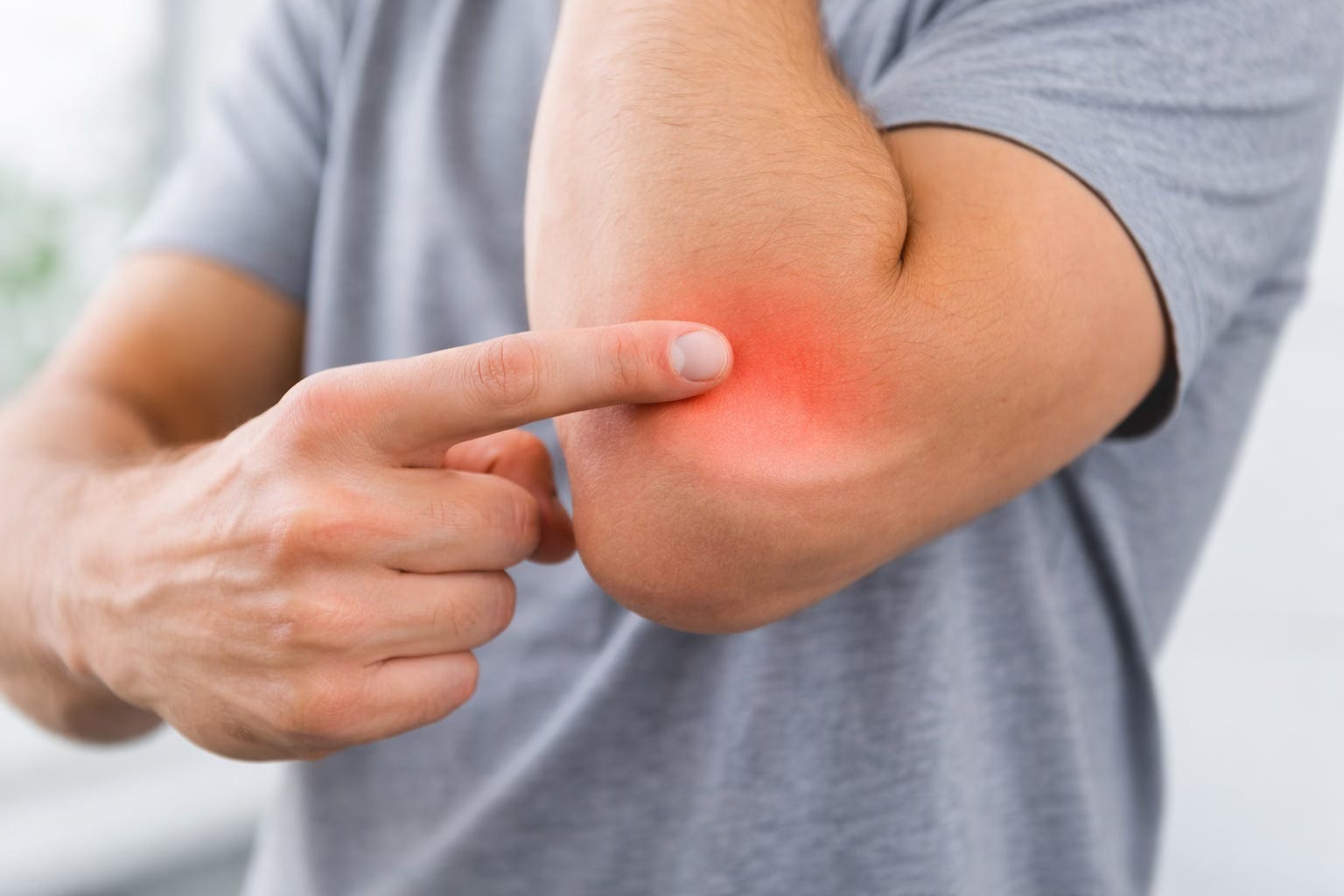
The correct term for tennis elbow is lateral epicondylitis — or more accurately, lateral epicondylar tendinopathy. The “itis” suffix implies inflammation, and for a long time, that’s how we understood and treated it. The research has since made clear that inflammation is not the primary driver. What we see histologically in affected tendons is disorganized collagen, degenerative tissue changes, and an absence of the inflammatory cells you’d expect if this were a true inflammatory process (Nirschl and Ashman 2003). This is a tendinopathy — a failed healing response — and treating it like an inflammatory condition is a significant part of why so many people end up with chronic, recurrent pain that doesn’t fully resolve.
The Natural History: It Will Get Better
This is the most important thing I can tell you about lateral epicondylar tendinopathy: the natural history is highly favorable. Meaning… The majority of cases resolve on their own within 6-12 months of onset, often sooner. That does not mean you simply wait and suffer — there are meaningful things you can do to reduce pain and speed recovery. But it does mean that the baseline trajectory, even without aggressive intervention, is toward resolution. Surgery is almost never needed for tennis elbow. Seriously… almost never. You very often just need to wait longer. I’ll explain below.
What Doesn’t Help — And What Actually Makes It Worse
Corticosteroid injections are the intervention I want to address most directly, because they remain commonly offered and the evidence against them, particularly for long-term outcomes, is consistent and compelling. Cortisone injections for tennis elbow should be avoided in most cases. Let me explain…
For subscribers: A downloadable guide is available below.