

Somewhere in the last few decades, many of us got very good at planning for one version of retirement, and unfortunately many have never started planning for the other.
You know the first plan well… Contribute to the 401(k) and max out your employer’s match. Meet with the advisor every year or two, adjust the allocation as you get closer to the finish line, and watch the number grow... hopefully.
But I want to ask you a question I ask a lot of my patients. You saved enough to travel, to spoil your grandkids, to finally take up the hobbies you kept postponing for forty years. But… Have you built a body that can actually do any of that?
Because I see the other version of retirement all the time, and it is not about money. It is a person who did everything right on the financial side and closed up shop, left the office for the last time, and turned around to find that their body will not tolerate the walking tour they saved for, their balance will not tolerate the grandkids’ backyard, and their stamina will not tolerate the new morning walking routine.
Nobody warns you about this version. No advisor warns you about it, and no quarterly statement tells you how you are doing. So people fund the financial plan while quietly neglecting the other… the one that determines whether any of it means anything.
Why This Plan Matters More Than People Think
Your lifespan is how long you live. Your healthspan is how long you live well, relatively disease-free, independent, and capable of doing the things you actually want to do.
Most conversations about aging obsess over the first number and almost entirely ignore the second, which is truly unfortunate. Centenarians do not avoid chronic disease. They simply get it fifteen to twenty years later than everyone else, and they stay active, alert, and mobile until very close to the end. That gap, the years you spend capable versus the years you spend managing decline, is the entire game.
Think of it as squaring off the curve. Most people’s health tracks along fine through their forties, then starts bending downward as chronic disease accumulates… the goal of everything I write about is pushing that bend ten or fifteen years further down the road, so the flat, capable part of your life stretches out toward the end instead of ending early.
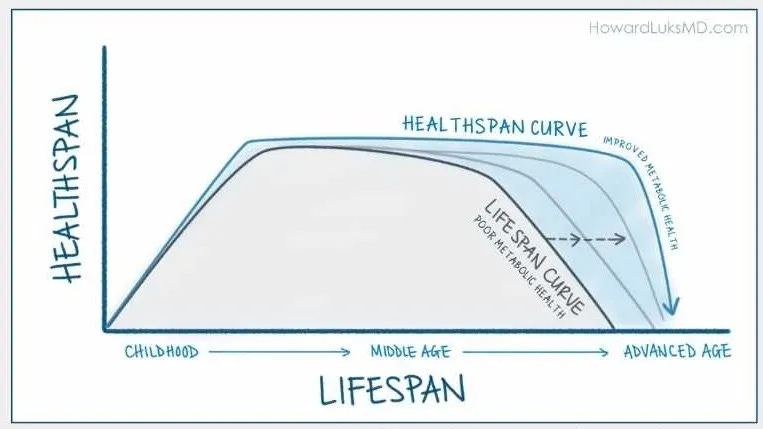
The reason this matters so urgently, and the reason I do not think it is dramatic to connect retirement planning directly to your physical training, is what actually causes the sharp decline at the end of most lives.
Frailty doesn’t crash… it creeps.
It is rarely a single catastrophic diagnosis. It’s decades of poor metabolic health, elevated lipids and A1c, rested muscles, and diminished aerobic capacity (VO2 max). It can also often be a fall. Weakness and poor balance creep in years before anyone notices. Then a fall happens. A few days in the hospital follow, and you come out weaker than you went in, because almost nobody prescribes real rehabilitation for it. You move less. The weakness gets worse. Getting out of a chair gets harder. The next fall is now more likely, and it might break a hip, and the recovery from that will cost you more function than the fall itself did.
You become less mobile, which makes you more vulnerable to infection, more sedentary, more insulin resistant, and eventually, a nursing home is the only realistic option because independent walking no longer is. Nothing about that spiral started with a dramatic event. It started with a small, ignorable erosion of muscle and balance that nobody was tracking, years before the first fall ever happened. I’ve seen this movie play out literally hundreds of times over my career.
No one wants to spend their last decade as a frail shell of the person they used to be.
The Asymmetry Nobody Warns You About
I’ve written before about the asymmetry of decline, and we should revisit it because it is the mechanism that makes the financial-retirement analogy hold up under.
Losing ten percent of your strength, your aerobic capacity, or your bone density in your forties is cheap. It comes back quickly, with a few months of consistent effort. Losing that same ten percent in your seventies is a different fight entirely, because aging muscle becomes resistant to the very stimulus that used to rebuild it easily, and thinning bone does not simply reconstitute itself the way it once did. The cost of rebuilding rises every decade you wait, the same way compound interest works against you if you start contributing to a retirement account at fifty instead of twenty-five. Except here, the interest rate is your own physiology, and it moves in the wrong direction the longer you put off funding the account.
The physical account is, if anything, more urgent than the financial one, because you cannot borrow capacity the way you can borrow money. There is no loan for muscle mass. There is no line of credit for a lower resting heart rate or better balance. What you build is what you have, and what you fail to build gets more expensive to acquire every year you wait.
Building the Other Retirement Plan
I built my book, Longevity Simplified, around seven straightforward habits because the science of aging well isn't actually complicated, even though the wellness industry works hard to make it feel that way. These seven habits are the line items in the other retirement plan. None of them require a gym membership you might not use, or a supplement stack that costs more than your actual retirement contribution. But they do require consistency, starting now, and the willingness to treat your body the way you already treat your money: an account that rewards early, steady deposits far more than it rewards a panicked lump-sum contribution at sixty-five.
For Members… Below I review the 7 categories I discussed in my book. Not in order of importance… they’re all important. We really can’t decide to pull one or two longevity levers at a time. We should strive to pull as many as we can, as often as we can.