
The Modules... A Framework About Training. Not Training Programs... But The Logic Behind Them.
This is the foundational information you rarely find that will help you craft a program that suits you.

This Module series is a step-by-step framework for building a system or body that performs well, progresses, and holds up over time. Each module covers one essential variable — tissue capacity, strength, aerobic fitness, intensity, recovery, load management, and progression — and explains not only what it is but also why it matters and how it interacts with the other variables. The series is written so that each module builds on the one before it, giving you a framework and the logic for thinking about training that goes far beyond individual exercises or workouts.
This is not a training program. It is the logic behind the framework that enables every solid program.
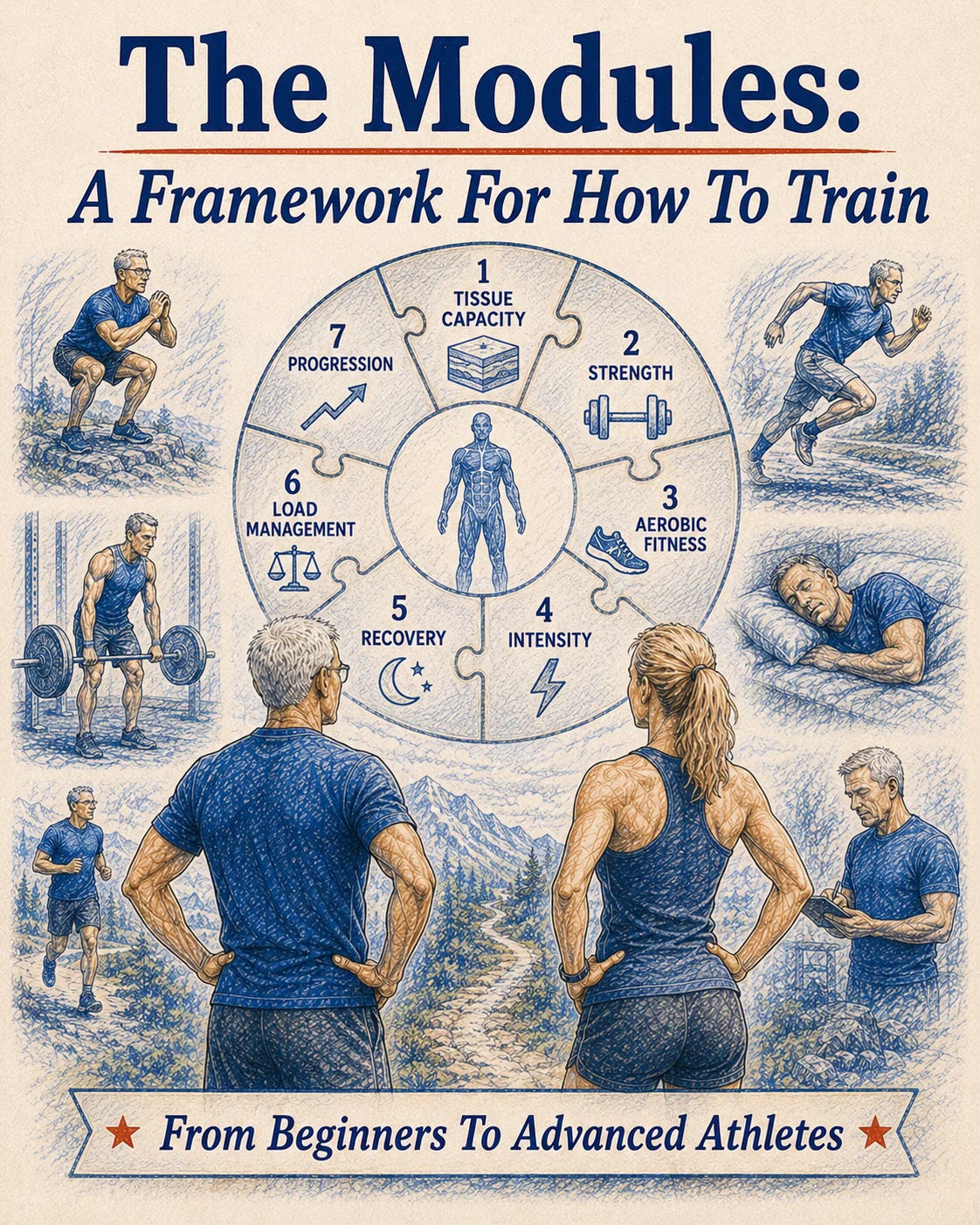
Whether you are starting from zero after years on the sideline or you just finished your second triathlon and want to keep improving without breaking down, the principles are the same. What changes is where you enter and how aggressively you load each variable. The modules give you the reasoning to make those decisions for yourself, rather than following a generic program that knows nothing about your life, your history, or your goals.
This is not a series of specific training programs, but it is the logic behind every good one. If you understand how these variables connect and how to manage them across a week, a month, and a year, you will train smarter, recover better, and stay in the game far longer than people who just chase the next workout.
All the modules written so far are outlined below. They are meant to be read in order, since each variable is just as important as the one that precedes it or follows it.
1. Module 1: You Are Not Fragile: Fragility is not the default state of the human body. It is an acquired state. This module challenges one of the most damaging ideas in modern health: that your body needs to be protected from stress rather than prepared for it. We explore how beliefs about pain, aging, and injury shape behavior long before training begins, and why the absence of stress is not neutral. It is a biological signal to decline... or “narrow”.
2. Module 2: Why Impact Matters: Impact is not a dangerous force to be avoided. It is a biological signal that tells bones how dense to be, tendons how stiff to become, and the nervous system how to stabilize and coordinate motion under load. This module reframes impact as a spectrum, from stepping off a curb to changing direction quickly, and explains why removing it entirely is a problem. The risks of avoiding impact depend on the capacity of the system receiving the force.
3. Module 3: Tendon and Tissue Capacity Most injuries do not happen because something suddenly breaks. They occur because your soft-tissue margins have quietly eroded. This module explains how tendons and connective tissues build or lose tolerance in response to the demands placed on them. Tendons are not fragile like glass. They manage the load and respond to the load they often see. Most tendon pain is not a sign of structural tearing. It is a sign of a mismatch between demand and capacity, and rest alone will not fix it.
4. Module 4: Strength for Longevity — How Much Is Enough? Strength in the context of longevity is not about performance ceilings. It is about margin: the delta between what your body is capable of and what life demands of it. This module walks through the dose-response relationship for resistance training, why the majority of health benefits occur at modest volumes, and why “enough” is actually enough. It is a strategy and explains why two to three modest sessions per week, maintained over years, outperform sporadic periods of high-intensity training followed by long injury-related or over-training-related layoffs.
5. Module 5: Building Your Aerobic Base: Your aerobic base is not built at the edge of challenge and difficulty. It is built well below it. This module explains why training below your first lactate threshold (easy pace) improves mitochondrial density, fat oxidation, and metabolic flexibility, thereby compounding the benefits over decades. Without a base, intensity becomes expensive. With a base, intensity becomes a tool. Aerobic base is your foundation, serving as the starting point for layering intensity. It determines how long you can tolerate life’s demands without systemic strain.
6. Module 6: Intensity and Locomotion: Intensity has a certain appeal. It feels productive and athletic. It also creates problems when it is introduced before the system is prepared for it. This module explains why the cardiovascular system adapts quickly to increased intensity, but connective tissue does not, and why most people need far less intensity than they think. We also discuss how locomotion exposes capacity gaps that can lead to injury. Intensity is not something to avoid. It is something to earn.
7. Module 7: Recovery Is a Superpower: There is a moment many people encounter where the same workout they have done for years no longer resolves the way it used to. That’s not due to a loss of fitness. It is a change in our recovery capacity. The biology of aging is real… and we can’t avoid it. This module covers how adaptation occurs during the recovery phase, and not during the session itself. It also explains why our recovery burden increases with age and how to read the signals your system provides. Recovery should not be an afterthought. It is the variable that makes consistency possible.
8. Module 8: Load — Building a Week That Works: A training week only works if it can be repeated. This module shifts from understanding individual variables to assembling them into a sustainable structure. It covers why different types of training impose different physiologic costs, how to distribute stress across a week so each session sets up the next one, why life stress belongs in the same conversation as training stress, and how to respond when the system tells you something needs to change.
How can I access the modules?