


For months now, we’ve broken training down into chunks. A session for your lower back; a session to protect your ability to get up off the floor; as well as a session built around bone density and heavy loading.
We built them around one problem, one muscle group, or one kinetic chain at a time. Those were the pieces of the puzzle… Today we show you one way to fit the pieces together into a 4-block program of 3 supersets.
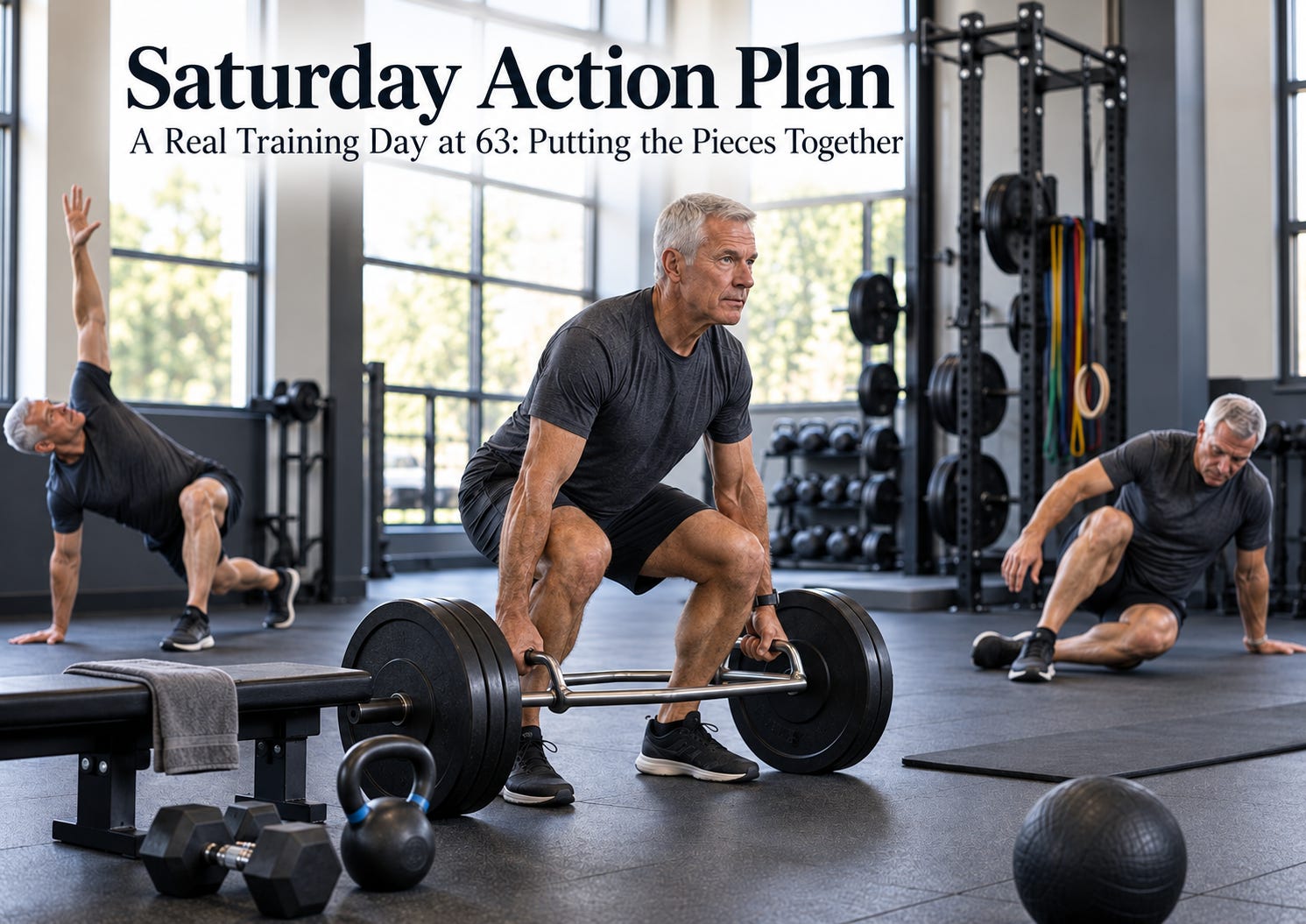
This is how Stephen Portee will train me later today. I believe it’s worth seeing how the individual sessions we’ve built together over the past few months add up to one real workout in one real training life.
This is the session I will execute: four blocks, warm-up through accessory work, with loads, reps, and tempo suggestions. Where a tempo is listed, the number is the count in seconds for the lowering phase of the lift, so a five-count down means you control the weight downward for a full five seconds before driving back up. That slow eccentric phase is hard, and skipping it to move faster defeats the purpose of including it.
If you live in my area of NY and need an amazing team of strength coaches, I highly recommend working with Apollo Performance Training.
This Action Plan is for informational and educational purposes only. It is not intended as a substitute for professional medical advice, diagnosis, or treatment. It does not replace an individualized evaluation or program from a physician, physical therapist, or other qualified healthcare provider who knows your history and can examine you directly.
Always consult your physician or other qualified healthcare provider before beginning any new exercise program, especially if you have any underlying medical conditions, injuries, or concerns. Participation is voluntary and at your own risk. Injuries can occur, and occasionally do.
The workout that follows will be my session for today. I outlined in this guide why I do these types of exercises, what abilities I’m trying to maintain, and how often I do them.

This guide explains what is actually changing in midlife physiology and the specific levers that can change the trajectory: muscle mass, power, bone density, joint health, hormones, metabolic health, recovery, protein, sleep, and more. The framing is simple: decline isn't inevitable the way most people think. The biology still responds. You just have to give it the right signal.
Members get this guide for 50% off. The code will be below.
Warm-up: Performed as a superset.
The goal here is not to burn calories before the real work starts. It’s to wake up the neuromuscular pathways, the hips, the rotational core, and single-leg control so the heavier lifts that follow are a little safer.
If you’re unstable on single-leg work on the first set, sometimes that’s normal- it is for me. Then the second set gets better, and I nail the third set. That’s your brain-muscle connection warming up. Another option is to use a broomstick or PVC pipe in your free hand to stabilize yourself so you don’t fall over.
Hamstring Bridge + Reach
Lying on your back with feet planted, bridge your hips up while reaching both arms overhead and to one side, and then the other… alternating sides for a full minute. This primes the posterior chain and the shoulders together, and the alternating reach adds a light anti-rotation demand before you’ve even started the session.
x 1 minute, alternating sides. 3 sets, not to failure.
Band or Cable Rotation
Standing with a band or cable anchored to the side at chest height, rotate your trunk (not quickly)
to pull the handle across your body and back, controlling the return rather than letting the band snap you back. This wakes up the same rotational pattern the med ball slam will train power for later in the session… at a fraction of the intensity.
x 12 each side. 3 sets. Not to failure.
Hand Supported Shrimp Squat
Holding a rail or a chair for light support, bend one knee behind you and squat down on the standing leg as far as you comfortably can, then stand back up. This is a serious single-leg strength and balance test even with the hand support, and it’s exactly the kind of movement that prevents losing single-leg control.
x 12 each side. 3 sets. Not to failure.
For Members, your warm-up is over, and the next 3 blocks of the real workout begin… 10 more exercises and 3 more supersets. This will be a challenging workout… Let’s do this…