

Substack is a wonderful place to write, but it's frustrating to find anything older than a few weeks because once a post slides off the front page, it is effectively buried. Many of you have written to ask where you can find what I wrote about tendon pain, knee arthritis, bone density, GLP-1 medications, or how we should train as we get older, so I went back through everything I have published and organized it by topic. If you are new here, please read the Start Here post first, because it explains what this community is about and how I think about healthspan, the years we get to live well, independent, and fully capable.
Please leave me a comment at the end and let me know if these summaries are useful…
Thanks, Howard

Within each of the 10 topics below, the first five posts are the ones that have resonated most with all of you, and each comes with a note about what it contains. Below those, you will find a few more posts on the same topic that are well worth your time. I will update and release this post every 6 months. If you are looking for something and can’t find it here, leave a comment and let me know, because that tells me what I should write next. And yes… I used Claude and Astra to help organize this after I fed them my content library and relevant statistics.
I also have many advanced guides over at Gumroad… Members get 50% off. The code is at the end of this piece.
Check out the Guide Bundle (3-in-1). Midlife athletes are constantly sold isolated, ineffective solutions: A new recovery tool, a tendon supplement, a training hack, a single biomarker, or a protocol promising to reverse aging… the list goes on and on. And most of that misses the point: Staying capable requires a system.
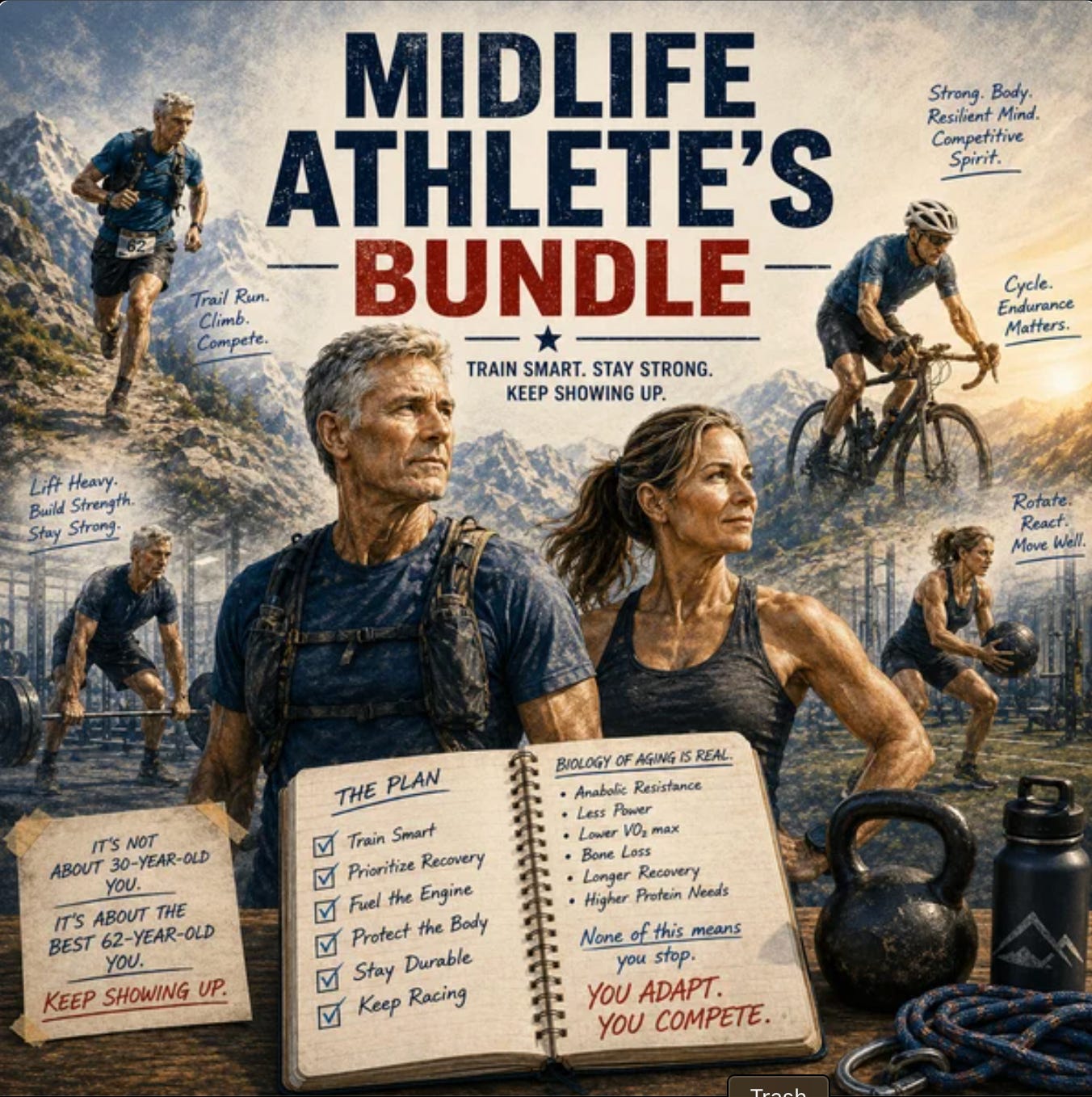
This bundle brings together three practical guides on how to structure training, understand and manage tendon pain, and interpret the metabolic markers that influence long-term health. It is designed for athletes who want to keep showing up, protect what allows them to train, and make better decisions about how they age.
Joint Pain and Arthritis
Most of the joint pain we develop in midlife, whether in the knee, the hip, or the shoulder, has far less to do with parts wearing out than we have been told, and these posts explain what is actually driving it and why movement is almost always part of the answer.
No, Exercise Doesn’t Cause or Worsen Osteoarthritis. Keep Going, If You Can. If someone has told you to slow down and protect your joints because you have arthritis, start here. I explain why osteoarthritis (OA) is driven far more by biology and metabolic health than by use, and why staying active protects the joint rather than harming it.
Chapter 11: Metabolic Health and the Health of Your Knees. This chapter from my knee osteoarthritis book is for anyone who wants to understand how blood sugar, visceral fat (the fat stored deep around our organs), and blood pressure feed inflammation inside the knee, and which small, consistent changes in walking, strength training, nutrition, sleep, and stress can ease pain and slow progression.
Exercise and Knee Arthritis: Can Exercise Decrease Pain AND Increase Cartilage Thickness? If you were told you have knee arthritis and quietly stopped running, hiking, squatting, or cycling to protect what’s left, this review of a new study will help you understand why that plan can backfire, and whether exercise can reduce pain and even increase cartilage thickness.
The Frozen Shoulder: Common, Often Misunderstood, and Frequently Mismanaged. If you woke up one day with a severely painful, stiff shoulder and can’t recall an injury, this post explains how a frozen shoulder (adhesive capsulitis) typically behaves, why it is so common in perimenopausal women and in people with diabetes or insulin resistance, and why it is so often mistaken for a rotator cuff problem.
Can High-Impact and High-Intensity Exercise Delay Joint Replacement Surgery and Improve Joint Health? This one is for those of us with hip or knee arthritis who have been told to avoid impact and take it easy, and it looks at two recent studies, along with the story of one of my patients, that point to a very different lesson.
The Silent Culprits: How Sedentary Lifestyles and Poor Metabolic Health Exacerbate Joint Issues
‘Revolutionizing’ Osteoarthritis Treatment: The 4Moving Biotech Story...
The Causes of Osteoarthritis: Debunking the “Wear and Tear” Myth
Tendon Pain
Tendon pain is one of the most common reasons people come to see me in the office, and these posts explain why our tendons hurt, why rest so rarely fixes them, and how gradually loading them helps them recover.
Tendons: Why They Hurt and How To Treat Them. Hint: It’s Not Rest. This is my most complete overview of tendinopathy, the umbrella term for a tendon that has become painful because it failed to adapt to what we asked of it, and it is for anyone with a tendon that won’t settle down. You will learn why rest alone is never enough and how a sensible progression from isometrics (holding a muscle contraction without moving the joint) to heavy strength work helps tendons heal.
Why the Outside of Your Hip Hurts: Understanding Gluteal Tendinopathy. If lying on your side, climbing stairs, or getting out of the car has become painful on the outside of your hip, this post explains why what we called bursitis for decades is usually gluteal tendinopathy, and why repeated injections can make the problem worse over time.
Module 03: Tendon & Tissue Capacity. Part of my training module series, this post is for anyone who assumes injuries happen because something suddenly snaps, and it explains how most joint and tendon pain develops gradually when the load we place on a tissue outpaces the capacity we have built.
Why We Should Not Immobilize Most Non-Surgical Tendon Injuries. If you have been handed a brace or boot for a tendon injury and told to come back in a few weeks, read this short rant first: tendons depend on load to maintain strength and organization, and those weeks of immobilization can add months to your recovery.
NSAIDS: When Are You Muting the Signal Your Body Needs to Adapt and Heal? For those of us who reach for ibuprofen after a long run or a heavy session, this post explains why acute inflammation is part of how our bodies heal and adapt, and why routinely taking NSAIDs (non-steroidal anti-inflammatory drugs) may undermine the very adaptations we are training for.
TENDONS: Why They Hurt, Why They Hate Rest, And Why Your Overall Health Matters
The Real Reason Your Shoulder Hurts - And Why Rest Won’t Fix It
MRI, Injuries and Surgery Decisions
An MRI report can be frightening to read, and these posts will help you understand what those findings usually mean, when surgery is and isn’t the answer, and how to come back well after an injury or an operation.
When MRI Abnormalities Are Not Abnormal: “Age-Appropriate” Changes Found in 95% of Shoulders. If you are holding an MRI report full of words like tear and degeneration, this is the post I most want you to read, because it explains why very little of what we see on an MRI explains pain, and why so many people with frightening scans function really well.
Why Most Rotator Cuff Tears Don’t Need Surgery... Why Is That? This one is for anyone who has been told they have a rotator cuff tear, and it walks through how the rotator cuff works, how most cuff tears develop, and why many of them do not require surgery, so you can have a better conversation during what is often a very short office visit.
Coming Back After Injury, Surgery, or Illness Without Breaking Yourself a Second Time If a torn rotator cuff, a fracture, a bad back, a long illness, or cancer treatment has brought your training to a halt, this post lays out how to return without breaking yourself a second time, based on the hundreds of athletes I have helped through that same stretch.
Why Your MRI Might Mislead You.. and Scare You Written for anyone over 40 who has been scared by an MRI report, this post explains why thinning cartilage, drying discs, and small tendon and labral tears are usually normal, age-appropriate changes rather than injuries, and not necessarily the cause of your pain.
Do I have a severe knee injury? If you twisted your knee on the pickleball court and it swelled up an hour later, this post explains what we listen for and look for in the office to decide whether an injury might be serious, which can help you decide how quickly you need to be seen.
Rest Is Not Free: The Cost of Completely Shutting Down After an Injury
Five Signs To Look For To Know If Your Knee Injury Might Be Serious
Does meniscus surgery decrease your risk of needing a knee replacement?
Training, Strength and Fitness
This is the largest section, because training is how we build the capacity to keep doing what we love, and these posts cover aerobic training, strength work, recovery, and how I structure my own weeks.
Training at 62: What I Do, Why I Do It, and What’s at Stake If I Don’t. Many of you asked what my typical training week looks like, so this post walks through it, explains the reasoning behind each piece, and what I believe is at stake for all of us if we stop.
Saturday Action Plan: Strengthening Your “Core.” If the word core makes you think of visible abs, this workout treats it as what it really is: the system of muscles around the spine, pelvis, and hips that keeps us stable while we walk, bend, lift, and carry, with exercises that work for beginners and competitive athletes alike.
What Happens to Your Body When You Walk 30 Minutes a Day. This is for anyone who wonders whether a daily walk is enough to make a real difference; it covers the physiological changes that 30 minutes a day brings, evidence from large studies and clinical trials, a realistic timeline for improvement, and how to progress when you are ready.
Saturday Action Plan: Hips and Glutes. Our hips power nearly everything we do on our feet, and this workout, laid out in my Enough, Better, Optimal framework so you can start at whatever level fits you today, builds glute strength and restores hip internal rotation, which is often the first motion a stiffening hip loses.
The Myth of Zone 2: Why Zone 1 (and Even Zone 0) Might Be Your Secret Weapon for Longevity As Well as Performance If all the Zone 2 talk on podcasts has you confused or intimidated, this post explains why Zone 0 and Zone 1 training, think brisk walking and easy cycling, is where most of us will gain the most for our healthspan, and why it requires so little recovery that we can do it every day.
Saturday Action Plan: Home Exercises Part 3, Core, Abdomen, Lower Back, and More
Training The Forgotten Plane: Why You Need to Train Rotation
Training at 63: What The Past Year Taught Me. Birthdays Enable Me To Reflect.
Falls, Balance and Power
A fall is one of the most consequential events of our later years, and these posts explain why balance and power fade earlier and faster than strength does, and how to train balance, quickness, and power back.
Saturday Action Plan: Balance Training. Balance is about keeping control as the world moves beneath you, reacting to a slip or a stumble, and because we lose it before we lose strength or endurance, this session is for everyone, from pitchers and tennis players to seniors who want to stay steady and mobile.
Preserving Your Ability to Get Off the Floor: Saturday Action Plan. Far too many people lose the ability to get down to the floor and back up long before they should, and this workout is for anyone who wants to protect that ability or rebuild it.
Neuromuscular Control: The Skill We Start Losing Earlier Than We Think. Neuromuscular control describes how well your brain and your muscles communicate, and this post explains why it is what lets you step off a curb without looking down or recover when your foot lands on uneven pavement, and why it deserves our attention as we age.
Saturday Action Plan, Lateral Movement: The Directions You’re Not Training. If your training lives in squats, deadlifts, rows, and presses, this session adds the side-to-side and angled movements, along with the quickness, that daily life demands when we step off a curb at an angle or pivot in the kitchen with a heavy pot in hand.
You Didn’t Fall Because You Tripped - You Fell Because You Didn’t Recover. This story from a 13-mile trail race I ran with a group averaging about 62 years old shows why falls are usually about losing the power and quickness to recover from a trip, rather than the trip itself.
Bone Health and Menopause
Bone is living tissue that responds to the loads we place on it, and these posts cover osteoporosis, DEXA scans, the exercises that actually build bone, and the misinformation that targets women during menopause.
Saturday Action Plan: 6 Exercises That Build Bone Density. This workout is for women and men alike, because roughly 1 in 3 women and 1 in 5 men will develop osteoporosis, and it shows you how to train for bone density whether you are starting early or already have the diagnosis.
Selling False Hope vs. Building Real Bone Density If your social media feed is full of weighted fanny packs, rebounders, vibrating platforms, and wearable belts promising stronger bones, please read this before you buy anything, because most of these products do not build new bone, and slowing bone loss is very different from adding density.
Beyond the T-Score: What Your DEXA Scan Actually Tells You (and What It Misses) and Why New Ways To Analyze Bone Might Be Better This post is for anyone who has had a DEXA scan and wants to understand what the T-score (the number that compares your bone density to that of a healthy young adult) tells you, what it misses, and why newer ways of analyzing bone may be more useful.
Muscle, Menopause, and Misinformation: What Women Deserve to Know If you have been told that your body stopped responding to training after menopause, this post explains why women aged 40 to 65 and beyond still respond well to resistance training, and why you don’t need to buy a special plan or supplement to get stronger.
Osteoporosis Prevention and Treatment: How Much Force Do Your Bones Need? Osteoporosis is silent until something breaks, and this post explains how common osteoporotic fractures are, how much force our bones actually need to build density, and includes an exercise guide to help you get started.
Metabolic Health, Labs, and GLP-1 Medications
Our metabolic health quietly shapes our joints, tendons, heart, and brain, and these posts cover insulin resistance, nutrition, the lab results that can mislead athletes, and the GLP-1 medications that are changing medicine.
The (not so) Hidden Links Between Metabolic Health, Joints, Tendons and Longevity. If you have joint or tendon pain without any injury, this post explains why a significant share of that pain is a downstream effect of poor metabolic health, and how high blood sugar, cholesterol, and uric acid can inflame our tendons and joints just as they damage our eyes, kidneys, and heart.
Thinking About Starting a GLP-1 Medication? Read This First. Written for anyone considering a GLP-1 medication, this post explains why the weight loss is really a side effect, and the metabolic correction is what can be lifesaving, which is how I would want you to think about these drugs before you begin.
The Deep Damage of Ultra-Processed Food. This is not another nutrition scolding, and it walks through a recent paper on how ultra-processed foods are built and absorbed and how they alter our brain, our gut, and our behavior, which goes well beyond the usual explanations about sugar or seed oils.
The GLP-1 Era: Why These Intestinal Peptides Are Reshaping Modern Medicine. If you want to understand why GLP-1 medications matter far beyond weight loss, this post explains how they act on the gut, brain, and metabolism; the evidence in heart, kidney, liver, and neurodegenerative disease; the newer combination drugs; and the real risks, including loss of lean mass.
Why AST and ALT Are Often Elevated in Endurance Athletes, and Why That’s Usually Not Indicative Of Liver Disease. Part of my Labs That Lie series, this one is for endurance athletes who have been told their liver enzymes are high, and it explains why AST and ALT are so often elevated in people who train hard and why that usually does not mean liver disease.
Summarizing the Role of GLP-1 Analogs (eg. Ozempic) in Treating Osteoarthritis
A High A1c in Runners/Athletes: Why It Doesn’t Always Mean You’re Pre-Diabetic
Brain Health
When I ask readers what they fear most about getting older, the answer is almost always dementia, and these posts explore what drives cognitive decline and the many things within our control that help protect our brains.
Eggs and Dementia Risk This short post looks at a study from the Rush Memory and Aging Project in which eating one or more eggs a week was associated with a lower risk of Alzheimer’s dementia, and at choline, the nutrient in egg yolks that may help explain it.
Alzheimer’s is not a disease of aging or primarily a plaque issue... it’s a disease of broken energy metabolism If you have watched someone you love decline and worry about your own future, this post reframes Alzheimer’s through the lens of metabolism and mitochondria (the energy producers inside our cells), explains why a large share of cases may be preventable, and considers where lithium might fit.
The Amyloid Hypothesis: How Research Consensus Cost Us Decades. A Deep Dive Into The Likely Causes of Alzheimer’s. This is the post for anyone who has asked whether clearing amyloid plaques will stop Alzheimer’s, and it explains how decades of research consensus around plaques may have sent us in the wrong direction, and why a lifestyle-first approach is not a consolation prize.
Why I’m Writing About Brain Health for the Next Year This short post explains why I started a year-long series on brain health and how it fits with the metabolic health, sleep, exercise, and nutrition fundamentals I wrote about in Longevity Simplified.
Dementia Risk and APOE4: What Carriers Should Actually Do About It. If you carry one or two copies of APOE4, the most common genetic risk factor for Alzheimer’s, or you are wondering whether to find out, this post summarizes the current evidence, the steps that can lower your risk, and what I would do if I were a carrier.
Aging Well and Longevity
These posts step back from the details to the bigger question of what we are actually optimizing for: a long healthspan with purpose, and they share what nearly 30 years of watching my patients age has taught me.
The ‘Longevity’ Stuff I’m Not Doing If the endless stream of longevity advice has you wondering what you might be missing, this post separates the signal from the noise, and from the outright nonsense, by walking through the popular longevity practices I have chosen not to adopt.
The Things This 63-year-old Orthopedic Surgeon Would Tell His 40-year-old Self This is what I would tell my 40-year-old self after decades of watching hundreds of patients I have known for more than twenty years, and it is for anyone in midlife who wants to understand how today’s quiet choices compound, for or against us, over the decades ahead.
The 5 Things I’m Doubling Down On at 60 At 60 I became far more interested in preserving what I have than in recovering what I’ve lost, and this post lays out the strategies I use to keep building and carefully maintaining muscle, strength, coordination, agility, and balance.
The Question That Changed Everything If you are disciplined about your health but stuck in a cycle of training hard, getting hurt, backing off, and starting over, this post shares the story of Paul, someone I know personally, and introduces the five questions of what I call the optimization audit.
We Weren’t Born to Exercise: Understanding a Prominent Evolutionary Mismatch If you have never loved exercise, this one is for you, because it draws on Daniel Lieberman’s work to explain why humans evolved to move with purpose and conserve energy rather than to exercise, and why struggling with it is an evolutionary mismatch rather than a moral failing.
Life, Medicine and Reflections
Not everything I write is about joints, tendons, or training; these more personal posts share reflections on family, time, and nature, along with what nearly 30 years of caring for patients has taught me about medicine and being human.
The Weight of a Word If you have ever been told that your joints are worn out or degenerating, this post explains how the words we doctors use can instill fear and keep people from moving, and why I believe we should describe osteoarthritis (OA) as a condition in which our joints are still capable of adapting rather than as a life sentence.
I’ve Been an Orthopedic Surgeon for 30 Years: What I’ve Learned From the Patients I Couldn’t Fix Some of the most important lessons of my career came from patients whose pain persisted even when the operation looked perfect on paper, and this reflection explains how they taught me to say less, listen more, and simply tell someone, “I believe you.” If you have ever felt unheard after a treatment that didn’t work, I hope it helps you feel seen.
The Day My Retina Tore... And What Having To Be Face Down All Day For 14 Days Teaches You In May, a few flashes of light and a new floater turned out to be two retinal tears and an early retinal detachment, and this post explains why those symptoms always deserve an urgent eye exam and what two weeks of staying face down after surgery taught me about being a patient. Most of us will eventually have a posterior vitreous detachment (PVD), which happens when the gel inside the eye peels away from the retina as we age, so this one is worth reading even if your eyes feel fine today.
At Jones Beach, Between the Tides of Time. What I expected to be a simple end-of-summer day at the beach with two of my older children turned into a reflection on memory, the passing of time, and the quiet grief of watching our kids build lives of their own. If you are a parent whose children are growing up and heading out into the world, I think this one will feel familiar.
The Last Snowman. This short note is about the morning my middle son and I built a snowman, not long after he graduated from college, and the moment I realized it might be the last time we would ever do that together. It is for every parent who has noticed that the beginnings of parenting slowly give way to softer, often unannounced endings.
If a friend or family member is dealing with one of these problems, sending them the relevant section is one of the kindest things you can do, and it helps this community grow. I will keep adding to this guide, so bookmark it and check back whenever you are looking for something specific.