

We’re going to talk about the physiology of training, how I train at 63, and how my experience in the office treating endurance athletes for 30 years, as well as my own experience, has shaped my current training regimen.
People on this platform often ask what my training actually looks like. Not necessarily the individual exercises or the studies I comment about, but what I actually do over the course of a week and, perhaps more importantly, why I do it that way.
The answer is somewhere between structured and deliberately uncomplicated.

Briefly, I usually train somewhere between nine and twelve hours each week. I run, ride, rock climb and lift. I usually run three or four times, ride once or twice, perform one short hill-repeat session, and resistance train three times. Some sessions overlap on the same day. In the winter, more of my aerobic volume comes from the bike. During the summer and fall, I run more and ride less. The underlying ‘ingredients’ don’t change very much; I simply change their proportions.
Physiology underlies all of this, but so does nearly a lifetime of trial and error. And that is what this post will be about. A lot of physiology.
At 63, I am no longer interested in proving how much training I can tolerate. I want to accumulate enough training to preserve and perhaps improve my aerobic capacity, strength, power, balance, muscle, and ability to run, while still being able to come back and train tomorrow.
Never let today’s workout ruin tomorrow’s
Through trial and error, that distinction has become increasingly important to me… And if you’re an aging athlete, it should be important to you too.
A heroic run or workout won’t change your fitness level… but the potential injury, and the resulting 3-6 month recovery, will alter your health dramatically.
I could run more miles than I currently run. I used to. I could make more of my workouts harder and longer. But that’s not what I’m training for. I’m training for life. The biology of aging changes the rules of training… You can adapt, or suffer the consequences. This is one of the most common conversations that I have in my office.
I train so my body stays capable of doing the things I want it to for as long as possible. And one of the lessons I’ve learned is that the workout that looks hardest isn’t necessarily the workout that moves you closest to that goal. It could be quite the opposite. I’ve seen far too many aging runners in my office who tried Norwegian 4x4s for VO2 max training and had to take off 3-4 months from running to recover from an injury. Then many would repeat that same mistake a year later. That’s not how you build long-term health and capacity. I’m not against 4x4 training… we all have a different capacity to absorb and recover from load. We also have different views on risk… so this is my take. It doesn’t need to be yours.
Most of My Training Isn’t Hard
This shouldn’t surprise long-term readers of Built To Move, Born To Heal.
People tend to assume that if someone is very fit, they must spend a lot of time training at very high intensities. In reality, much of my aerobic training is relatively easy, with a much smaller amount performed at considerably higher intensities.
This is the basic idea behind polarized training.
The terminology gets messy because researchers and coaches use different zone models, and not every training week fits neatly into one definition of “polarized.” But the underlying concept is useful: accumulate a large amount of relatively easy aerobic work, perform a much smaller amount of genuinely hard work, and avoid turning every workout into something moderately difficult.
Most runners run too hard on easy days and too slow on fast days. They’re in a moderate intensity rut. That middle ground is seductive. It feels productive because you’re breathing hard enough to know you’re exercising, but it isn’t necessarily hard enough to produce the adaptations you might get from a truly hard session. At the same time, it can be demanding enough to add fatigue and interfere with recovery and what you want to do tomorrow.
I don’t avoid moderate or tempo work. One of the bike rides I’ll show you here contains an intentional tempo ramp. But I don’t accidentally turn every easy session into a tempo session simply because I feel good that day. And that’s an important point. I do have a plan for each workout. And my easy days stay easy no matter how good I feel. I might dial back a hard day when I feel awful, but never the other way around.
Every workout should have a purpose, and the intensity should follow the purpose rather than my mood.
What an Easy Run Looks Like After Years of Training
This heart-rate trace is from a six-mile run last week. Let’s dissect it. It doesn’t look impressive at first… but if you understand physiology, it should. BTW… I use an H10 Polar heart rate strap. Wrist-based HR just isn’t reliable enough.
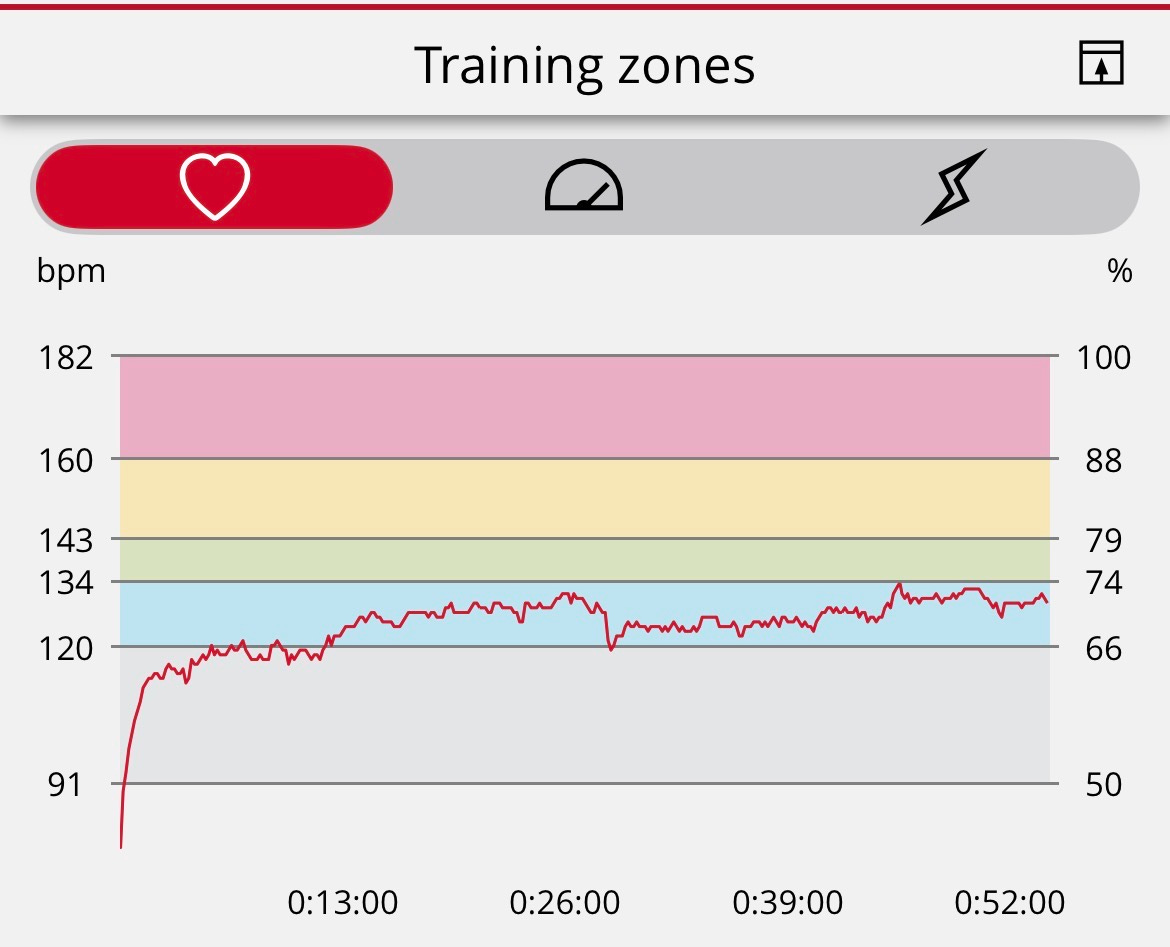
This is one of my routine aerobic runs at roughly a ~10-minute-mile pace.
What interests me about the trace isn’t the pace itself. Pace is highly individual and largely meaningless when comparing one runner with another. What interests me is what happens to my heart rate while maintaining that pace across the entire 6 miles.
First. It took me years to run this route with this level of heart rate control. This route has a few small hills, and you need to manage your pace to stay in the zone. This type of HR trace also reveals a great level of metabolic flexibility as well as mitochondrial fitness and efficiency.
Okay… so the trace shows that after the initial rise, my heart rate settles largely in the 120s and low 130s and stays remarkably stable. You’ll have to trust me that my pace stayed the same, except on the hills.
Cardiac drift is minimal, and that's worth understanding, especially if you use heart rate to guide your aerobic training.
Even in the fittest athletes, this can happen. During prolonged exercise, your heart rate can gradually rise even though your pace or cycling power hasn’t increased. That’s cardiac drift. As you exercise, your body temperature rises. You sweat, and your plasma volume can decline. More blood is directed to the skin to help dissipate heat, so stroke volume (the volume the heart pushes out with each beat) can fall, and the heart compensates by beating faster to maintain cardiac output (total volume/minute).
But the primary reason for cardiac drift in most runners is poor aerobic conditioning, although heat, humidity, dehydration, and accumulated fatigue can all magnify the effect.
Another related concept is aerobic decoupling, which is often more useful than looking at heart rate in isolation. Decoupling describes what happens when the relationship between your external workload and your internal physiological response begins to separate.
Suppose you begin an easy run at a 10-minute pace with a heart rate of 125. Forty-five minutes later you’re still running 10-minute miles, but your heart rate is 145.
Your pace hasn’t changed, but the physiological cost has.
Cardiac drift = HR rises at the same workload.
Aerobic decoupling = the relationship between HR and pace/power deteriorates over time.
They’re closely related because cardiac drift is one of the main things that produces aerobic decoupling. But decoupling incorporates the external workload, which is why it’s more informative for training.
Here’s another scenario. Suppose you start running at 10:00/mile and HR 125. An hour later you’re running 10:45/mile at HR 125 because you’re deliberately slowing down to remain in Zone 2. Your HR hasn’t drifted upward much because you’ve adjusted your pace, but HR and pace have still decoupled: you’re producing less external work for roughly the same cardiovascular effort.
Along those same lines.. When I can run around a 10-minute pace and maintain roughly the same heart rate across the session, that tells me something highly significant about my aerobic conditioning and durability at that workload.
It didn’t happen because of one magical workout.
It is the product of consistency accumulated over years. For many of you, that will mean walking a lot. Then walk/runs… initially walking more than you’re running. Then you’ll be able to run the flats while you walk the hills. And so on. This is a years-long process. But it’s one worth pursuing.
For Members, this is a long post where I cover various types of aerobic training, what adaptations I’m trying to drive, and how I interpret heart rate tracings from a physiological and metabolic perspective. It covers a lot of ground, including why I train these methods, why I use a bike despite not enjoying it much, what I do when I see meaningful cardiac drift, and how to manage it.